Poor image quality in e-commerce photography is often excused by time pressure: many products, little time. As a result, images are simply “brightened” – but rarely with any deliberate or controlled lighting. Yet it takes neither a large amount of additional equipment nor significantly more time to noticeably improve image quality. This example demonstrates how a clean, controlled, and high-quality result can be achieved with only minimal extra effort.
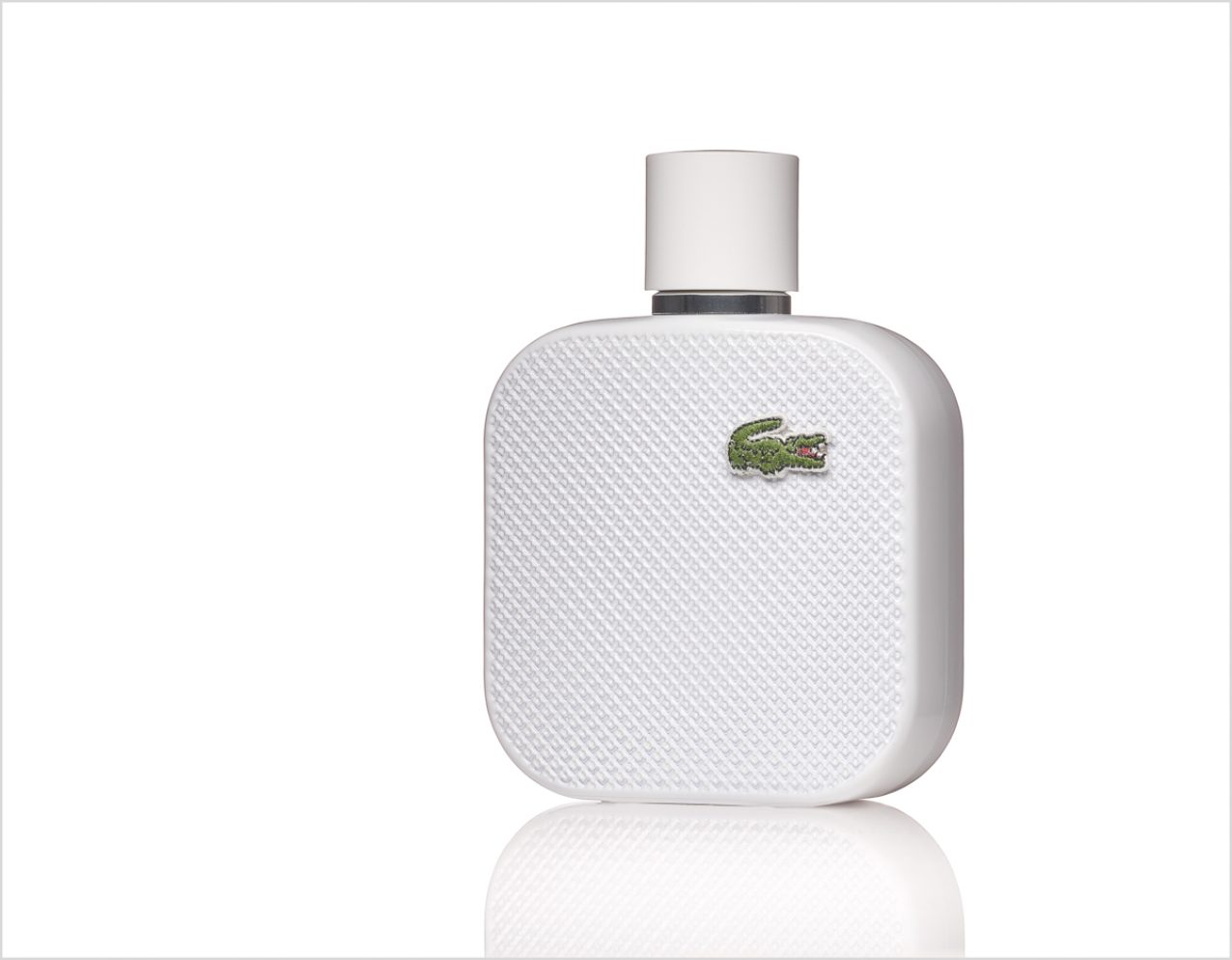
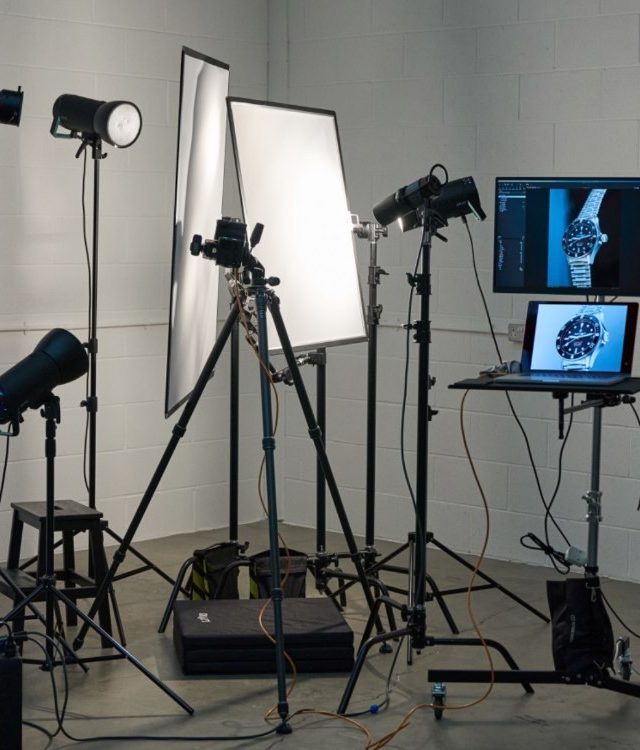
The subject to be photographed is a particularly demanding object: a white perfume bottle with a textured surface, curved sides, and a smooth, round cap – placed on a completely white background. The goal is a precise “white on white” result using the most reduced lighting setup possible, allowing for quick and uncomplicated adjustments. The setup begins with background and base, both made of glossy white acrylic sheets. The background is evenly illuminated using a Softbox 60 × 100 cm. Aperture and flash power are balanced so that the background reaches measured RGB values of 254/254/254. The result: scratches and imperfections in the acrylic sheet are completely blown out, without creating distracting stray light in the studio or overexposing the edges of the bottle. At this stage – even without any light on the object itself – the base already appears clean white, as it reflects the bright background. A low camera position further enhances this effect. A classic ground shadow is deliberately avoided. Nevertheless, the bottle retains its sense of contact with the surface, as the reflection on the acrylic sheet is not retouched away.
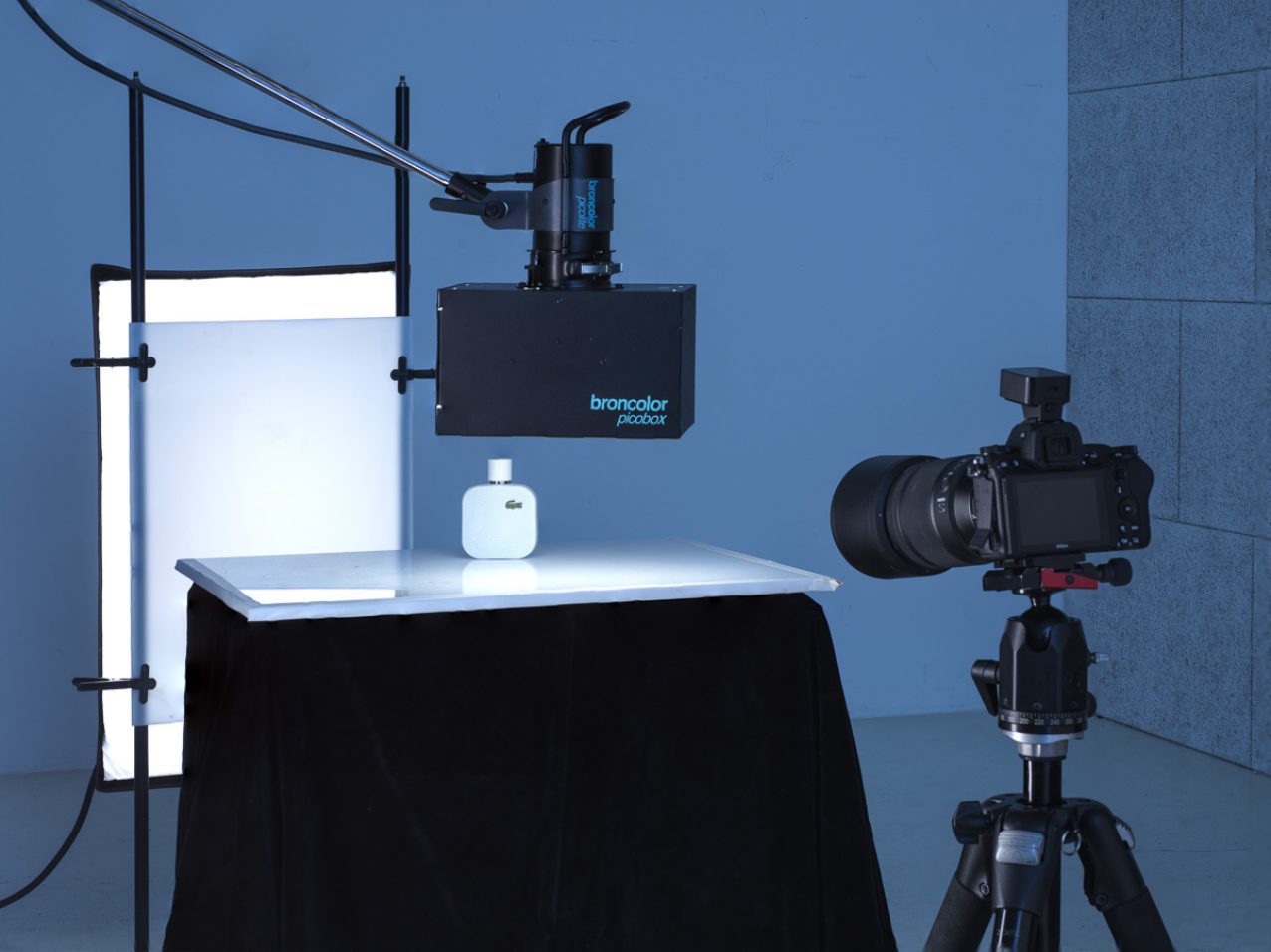
For the main light, choosing the correct size of the light source was crucial. Larger modifiers would inevitably have resulted in a loss of precision. Since the bottle measures only around 12 × 12 cm, a very small area light was selected: a Picobox mounted on a Picolite. It was positioned not above but in front of the object. This ensured that, despite the short distance, the cap was not overexposed. The left–right positioning was particularly critical. It created a subtle falloff in brightness on the left side of the bottle (from the camera’s perspective), gently emphasizing the rounded front. At the same time, the Picobox was placed far enough to the right to illuminate the right side as well, shaping it three-dimensionally through a fine gradation. While the lighting for background and base can remain unchanged for different products, the light can be quickly adapted to new objects with only minimal positional adjustments of the Picobox. To make the texture of the front optimally visible, any additional fill light was deliberately avoided. Only the reflections from the bright base were used for this purpose. For even smaller objects, it can be beneficial to rotate the Picobox by 90° and aim its short side toward the object. In this case, it is advisable to cover the front area of the base with black material. This light would have no aesthetic benefit and would merely reduce contrast unnecessarily. The image was taken with a digital full-frame camera and a focal length of 105 mm. At ISO 64, the aperture was set to f/16 and the shutter speed to 1/125 s.