
Walk into a company that has just built its own photo studio, and there is a good chance you will find LED panels. The choice seems obvious. LED fixtures have become bright, affordable and efficient, what you see is what you get, and with video now part of almost every content plan, one light for everything sounds like the modern answer.
Yet in professional product and portrait studios, flash is still the standard for stills. That is not tradition or habit. It comes down to physics: how much light each source delivers at the moment of exposure, and what happens to all the other light in the room.
The difference is larger than most people expect. An 800-joule studio flash puts roughly 40 to 50 times more light on the subject per exposure than an 800-watt LED: between five and six f-stops. That one number explains most of what separates the two in practice. It decides the depth of field you can afford at low ISO, whether motion freezes, and whether your pictures change with the office lights and the weather outside the window.
This article works through the numbers step by step, based on broncolor's published measurements. Both technologies can produce excellent photographs, so it also covers where continuous light is the better choice.
Two ways of delivering an exposure
A sensor responds to the amount of light it collects, not to brightness alone. With a continuous source, that amount is illuminance multiplied by the time the shutter is open:
H = E × t
H is the exposure on the subject in lux-seconds (lx·s), E the illuminance in lux, t the shutter time in seconds. Halve the shutter time and the exposure halves.
A flash works differently. It releases its whole burst within a few thousandths of a second, so as long as the shutter is open for the entire burst, the shutter time does not change the flash's share of the exposure at all:
H = Q / A
Q is the light released per burst in lumen-seconds, A the area it falls on in square metres. Two practical rules follow from this:
- With flash, the shutter time only affects the ambient light. Aperture, ISO and flash power set the flash exposure. A shorter shutter time leaves it unchanged and pushes down every other light in the room.
- With continuous light, key light and stray light scale together. Whatever you change on the camera affects both equally, so their ratio is fixed by how bright each one is.
How much light each source delivers
broncolor publishes photometric data for its flash units and for its LED F160, measured with the same P70 reflector at a distance of 2 m. That allows a direct comparison:
- Stelos 800 L flash at full power (800 J): f/45 at ISO 100. That is about 5,100 lx·s on the subject, whatever the shutter time.
- LED F160 (160 W) at full power: f/8 at ISO 400 and 1/60 s, which corresponds to about 2,400 lx. At 1/125 s, that is about 19 lx·s.
At 1/125 s, the flash delivers about 270 times more light: a gap of 8 f-stops. That comparison flatters the flash, because the LED draws only 160 W. An 800 W LED with five times the output would still be almost six f-stops behind the 800 J flash. Even an LED with a higher efficiency of 100 lumens per watt stays more than five f-stops behind.
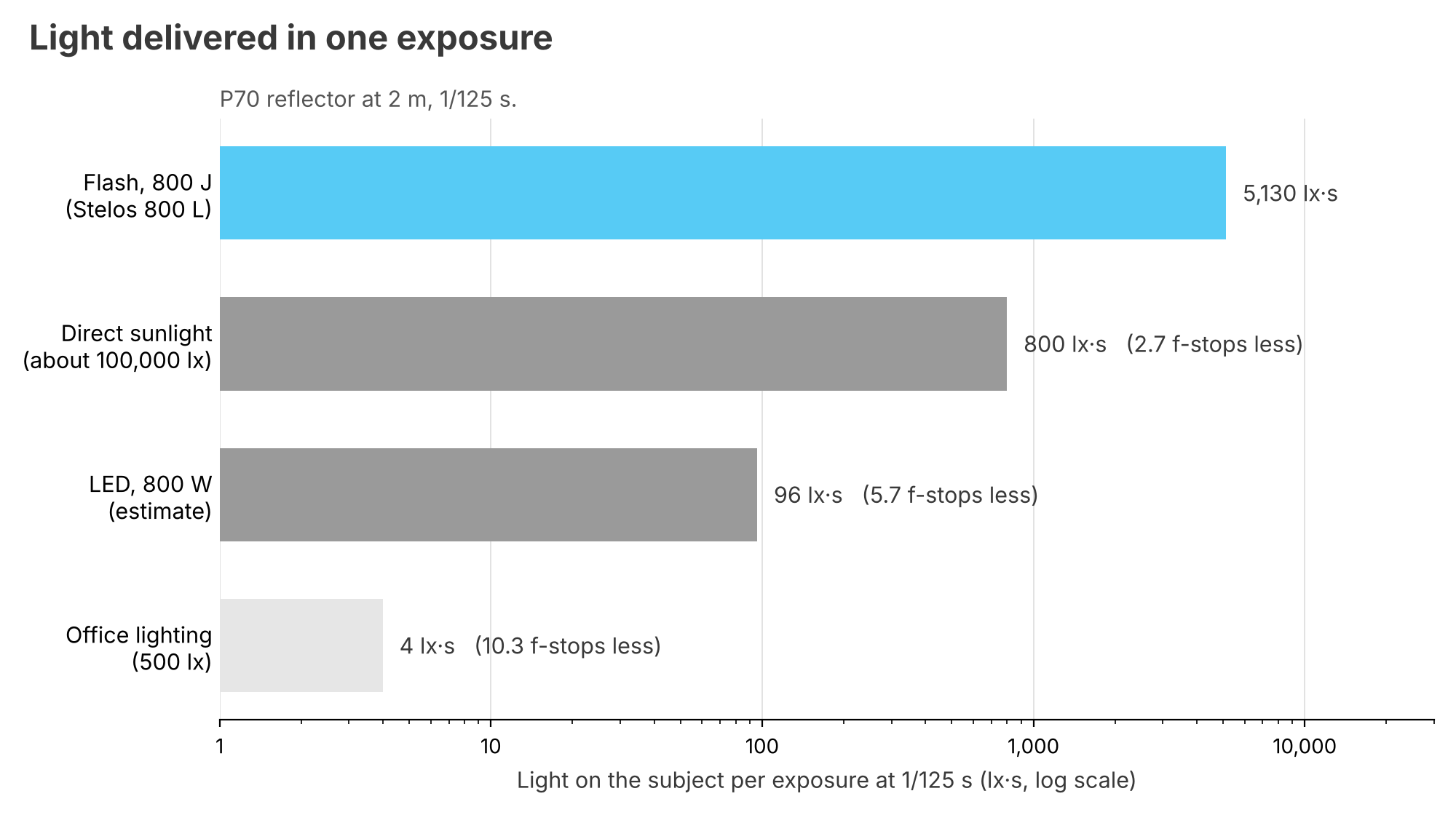
During its burst, which lasts about 1/250 s at full power, the flash puts around a million lux on the subject: roughly ten times the light of direct sunlight.
In practice, five to six f-stops is the gap between f/11 and f/1.4 to f/2. A product set lit with flash at f/11, ISO 100 and 1/125 s would need, with an equally rated LED, one of these instead:
- an aperture of f/1.4 to f/2, with a depth of field far too shallow for most products,
- ISO 3,200 to 6,400, with visibly more noise,
- or a shutter time of 1/4 to 1/2 s, which rules out handheld work and anything that moves.
Stray light: why flash ignores the room
Every studio has light it does not control: ceiling fixtures of unknown colour temperature and colour rendering, and daylight that changes through the day and from day to day. On location there is even less control. At 1/125 s, even bright daylight at a window adds only about 4 % to a flash exposure, but can provide two thirds of an LED exposure.
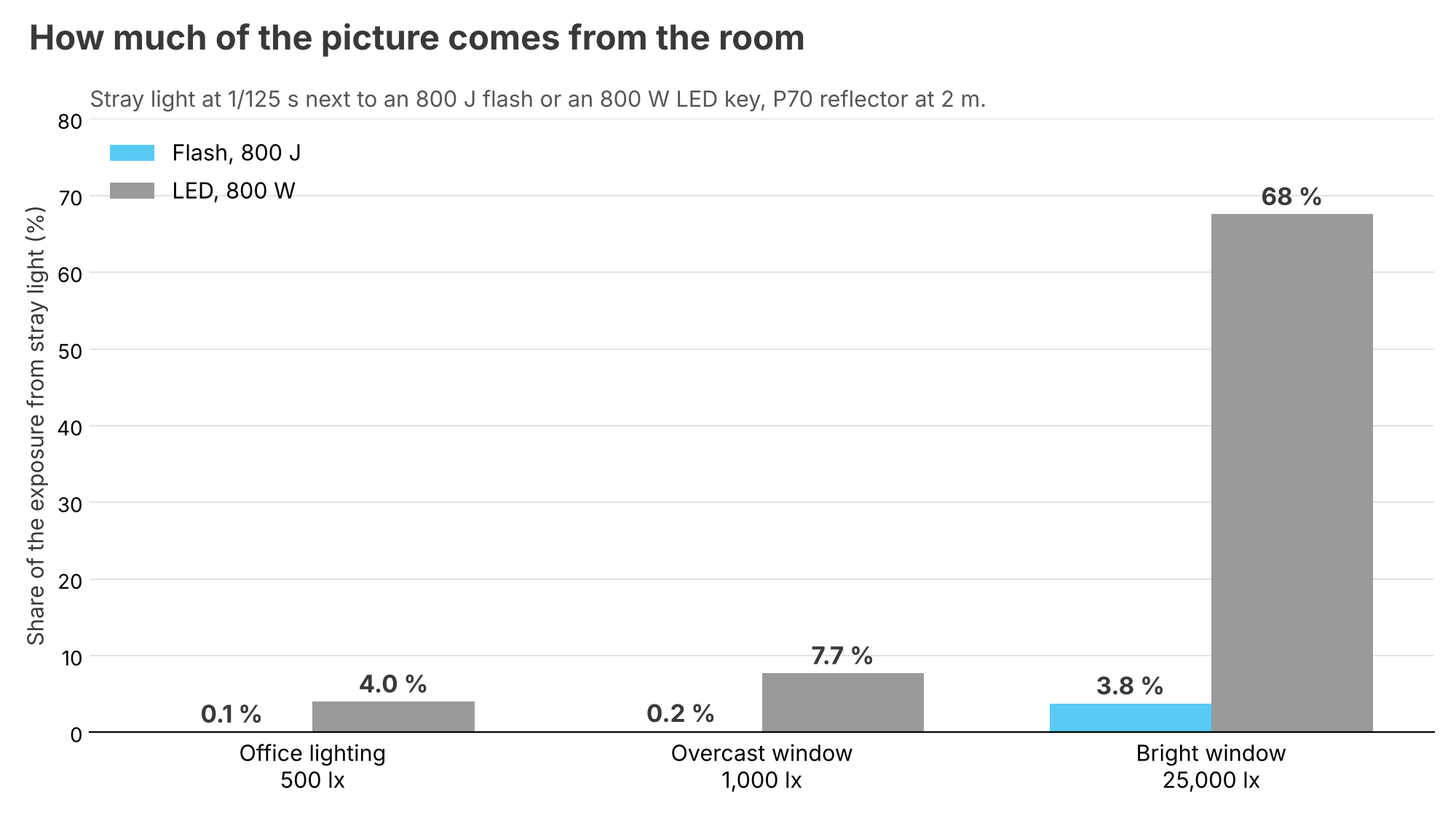
A worked example with the values above: an 800 J flash delivering about 5,100 lx·s, an 800 W LED delivering about 12,000 lx, and the camera at 1/125 s.
- Office ceiling lights, about 500 lx, add 500 × 1/125 = 4 lx·s. That is about 1/1,300 of the flash exposure, more than 10 f-stops below it. Invisible.
- Daylight at a window, 1,000–25,000 lx (from a dull overcast sky to bright indirect daylight), adds 8–200 lx·s: 4.7 to 9.3 f-stops below the flash. At most a trace in the deepest shadows.
- The same window next to the 800 W LED ranges from 3.6 f-stops below to 1 f-stop above the key light. The window can be the stronger source.
As a rule of thumb, stray light 5 f-stops below the key adds about 3 % to it and is rarely noticeable. At 2 to 3 f-stops below, it adds 12–25 % and shows up as a colour cast in the shadows, where the key light is weakest. With flash, a shorter shutter time (up to the camera's sync speed) pushes stray light further down. With continuous light, no camera setting helps: the room has to be darkened or the LED made brighter.
The practical consequence: a flash setup gives the same picture in the morning and the afternoon, in summer and in winter, under any ceiling lights. That repeatability is what high-volume in-house studios depend on.
Freezing motion: the flash duration is the shutter
When flash is the dominant light, the effective exposure time is the flash duration, not the shutter time. Depending on the unit and power setting, studio flash durations range from about 1/250 s at full power to well under 1/10,000 s at low power. The broncolor Stelos 800 L, for example, reaches 1/11,500 s (t0.1) at minimum power in Speed mode, and still 1/5,400 s at the highest power level Speed mode allows.
Two values are quoted for flash duration:
- t0.5 is the time the flash stays above half its peak. It looks short on a data sheet but leaves a tail.
- t0.1 is the time above one tenth of the peak. It includes most of the tail and predicts motion blur far better. Compare units by t0.1.
With continuous light, freezing a splash or a fabric flick takes a shutter time of 1/1,000 s or shorter. That is 3 f-stops less light than at 1/125 s, on top of the five to six f-stops flash already has in hand. The stray-light advantage matters here too: if the room light is 5 f-stops or more below the flash, there is no faint, blurred "ghost" image around the sharp one.
Colour: consistency matters more than the data sheet
Neither technology guarantees accurate colour on its own. What decides is how stable the light stays from shot to shot and across power settings. Three things to look at:
- Spectrum. A xenon flash tube emits a continuous, daylight-like spectrum. High-quality LEDs reach excellent colour rendering too, but values vary widely between fixtures. Check CRI (Ra, and R9 for reds) or, better, TM-30 or SSI, rather than relying on the nominal colour temperature.
- Stability across power. On a conventional flash, the colour temperature drops noticeably when output is reduced by several f-stops. broncolor's patented ECTC (Enhanced Colour Temperature Control), used in power packs such as Scoro, balances the cooler, bluish start of the discharge against its warmer end. The colour temperature varies by only ±50 K over the entire power range.
- The room. Stray light adds its own colour. Fluorescent tubes often carry a green tint; daylight shifts towards blue on overcast days and towards warm at the ends of the day. Because flash keeps stray light far down, these casts stay out of the picture. With LED, they mix into the shadows.
Accurate product colour still requires a camera profile, a grey card or colour chart in a test frame for each setup, neutral studio surfaces and calibrated monitors.
Several sets in one room
In a studio with several workstations, continuous light from one set is stray light for every other set. A 12,000 lx LED key spilling onto the neighbouring table is no different from a bright window, and it changes whenever the neighbour moves a light.
Flash avoids this in two ways:
- It only lights at the moment of exposure. A neighbour's flash only affects your picture if it fires during the few milliseconds your shutter is open. Modelling lights stay on, but they are weak compared with the flash and can be dimmed.
- Each set fires only its own heads. broncolor's RFS radio system offers studio addresses from 1 to 99, so each workstation triggers and controls only its own flash units. How many addresses are usable depends on the flash units connected.
Heat, comfort, energy, and when continuous light wins
Flash does not need a bright light shining continuously into a portrait subject's eyes, which keeps longer sessions comfortable. Tungsten continuous lights produce substantial heat; modern LED fixtures are far cooler and more efficient. Flash may use less electricity over a stills session because it delivers light only for exposures, but actual consumption depends on how often it fires, how much the modelling lights are used and which fixtures are compared.
Continuous light is the better choice when:
- video is a regular part of the work: a flash's modelling light is meant for previewing, not as a replacement for dedicated video lighting,
- the camera's shutter time is fixed above the flash sync speed and high-speed sync would cost too much power.
If a studio needs both, test the real filming conditions rather than assuming one setup covers stills and moving images.
At a glance
- Light on the subject: an 800 J flash delivers about 5,100 lx·s per exposure, an 800 W LED about 100 lx·s at 1/125 s.
- Typical gap: 5 to 6 f-stops in favour of flash.
- Room light and daylight: negligible with flash (about 5 or more f-stops down); with LED, it can match or exceed the key light.
- Lever against stray light: with flash, a shorter shutter time; with LED, only a darker room.
- Freezing motion: with flash, the flash duration does it, down to under 1/10,000 s at low power; with LED, it takes a shutter time of 1/1,000 s or shorter.
- Several sets in one room: flash sets work independently, each on its own radio studio address; LED light spills onto neighbouring sets.
- Preview: flash offers the modelling light, and with tethered shooting every frame appears on screen immediately; LED shows exactly what you get.
- Video: flash is not suitable; LED is the right tool.
Our recommendation: for a studio producing mostly product photographs and portraits, a well-controlled flash setup is the best foundation. Choose continuous light when video is central to the brief.
Flash and LED figures are derived from broncolor's published photometry for the Stelos 800 L and the LED F160 (P70 reflector, 2 m, incident-light meter constant C = 250). The 800 W LED is the LED F160 scaled up five times. Daylight values are typical ranges; office lighting is the common 500 lx guideline for office work.