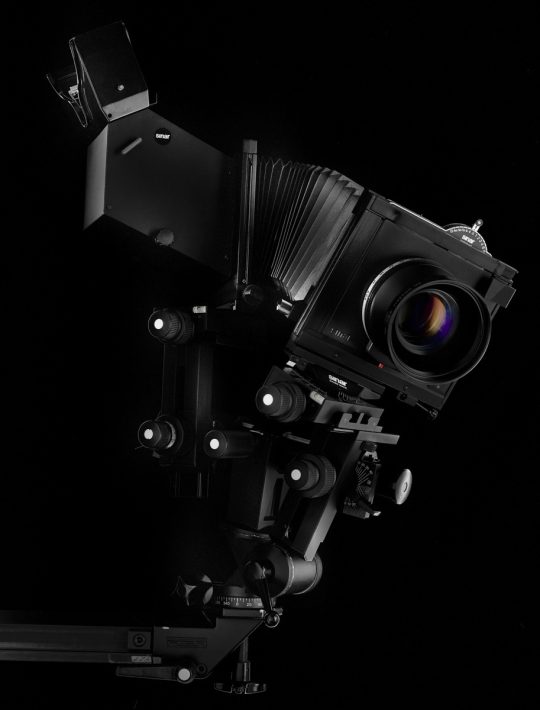
When I photograph dark, highly detailed objects, I don’t think in terms of adding light – I think in terms of shaping it. With a technical camera, every surface matters: the bellows, the metal edges, the glass. My goal is to control exactly what becomes visible and what stays in shadow.
For this shoot, I worked with the Move 1200 and the Senso 2400. What mattered most to me here was precision and consistency. I needed to be able to fine-tune power output and trust that the light remains stable across multiple exposures, especially since I planned to stack images later.
I always start by defining the shape. I placed a large Softbox 120 × 180 cm slightly behind the camera and carefully masked it. This creates a clean rim light along the silhouette without illuminating the background. It’s a subtle edge, but it gives the subject its presence. At the same time, I made sure to block the front of the camera so no direct light hits the lens – this helps me avoid unwanted reflections and keeps the contrast strong.
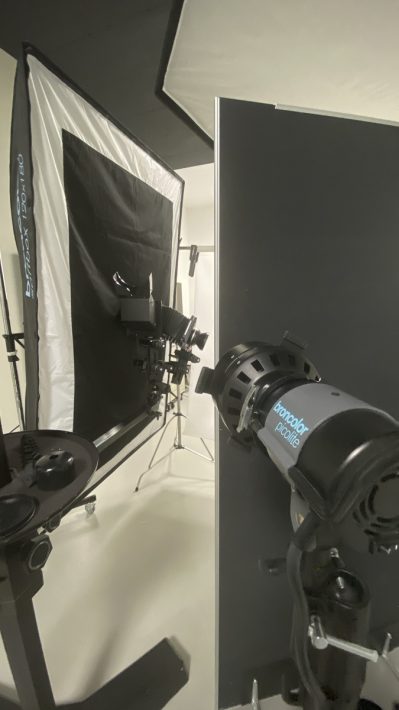
Next, I moved on to the bellows. Texture is everything here, but it needed to stay controlled. I used a Picolite from the left side, letting the light skim gently across the folds. I did not try to make them bright – I just wanted to reveal their structure. If the light is too harsh, the material loses its character, so I kept it soft and precise.
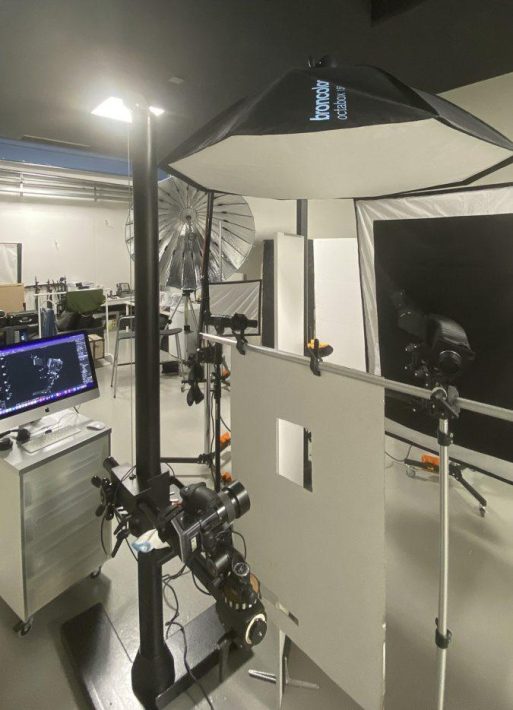
The lens is always the most delicate part. Since it reflects everything, I did not light it directly – I shaped what it reflects. I positioned a striplight on the right to define the lens form, then placed translucent paper in front of the light source. This softens the reflection and creates a smooth gradient in the glass. The result is clean and controlled, without distracting hotspots.
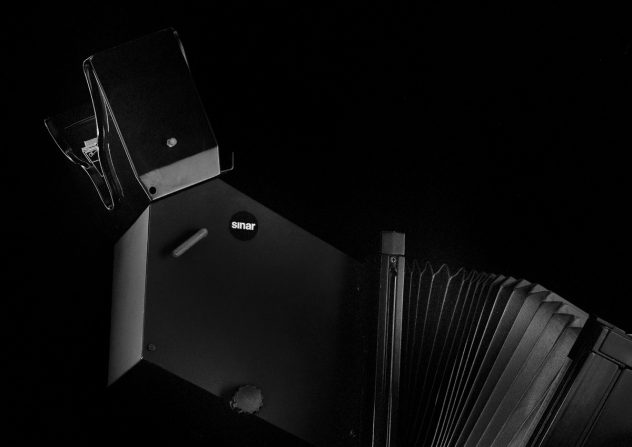
For the capture, I used the Hasselblad H6D-100c with a Hasselblad 120 mm macro lens. I like this combination because it gives me a natural perspective with no distortion, while still allowing me to capture extreme detail. To make sure everything is sharp – from the bellows to the front element – I shot a focus stack. Later, I combined the images in post to achieve full sharpness across the entire subject.
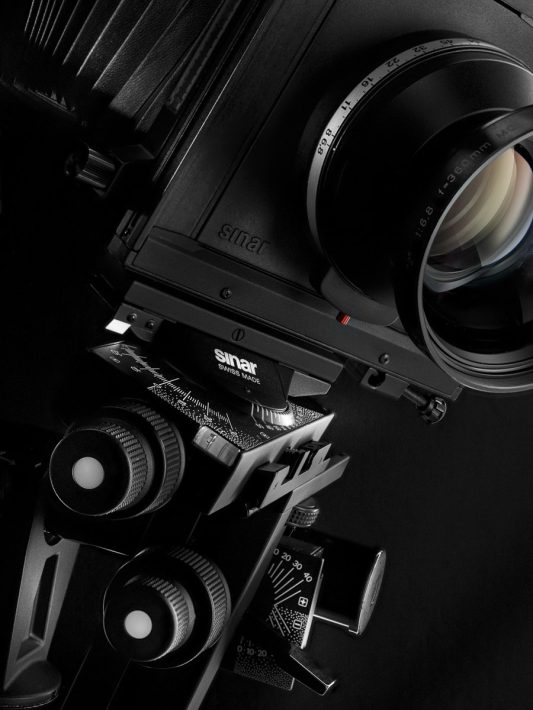
In the end, it’s not about how much light I use, but how precisely I control it. By carefully shaping highlights, protecting shadows, and managing reflections, I can bring out depth and detail – even in the darkest subjects.