How do you photograph a dance performance on the vertical wall of a theater so that the sense of lightness suggested by the title of the show is also visible in the images? Which light shapers and power packs do you choose to cope with the extreme backlighting of a sunny early summer day (we photographed between noon and 2 p.m. on the building's south-facing wall)? The following article describes some of the considerations behind the shoot—as well as a few of the solutions we found.
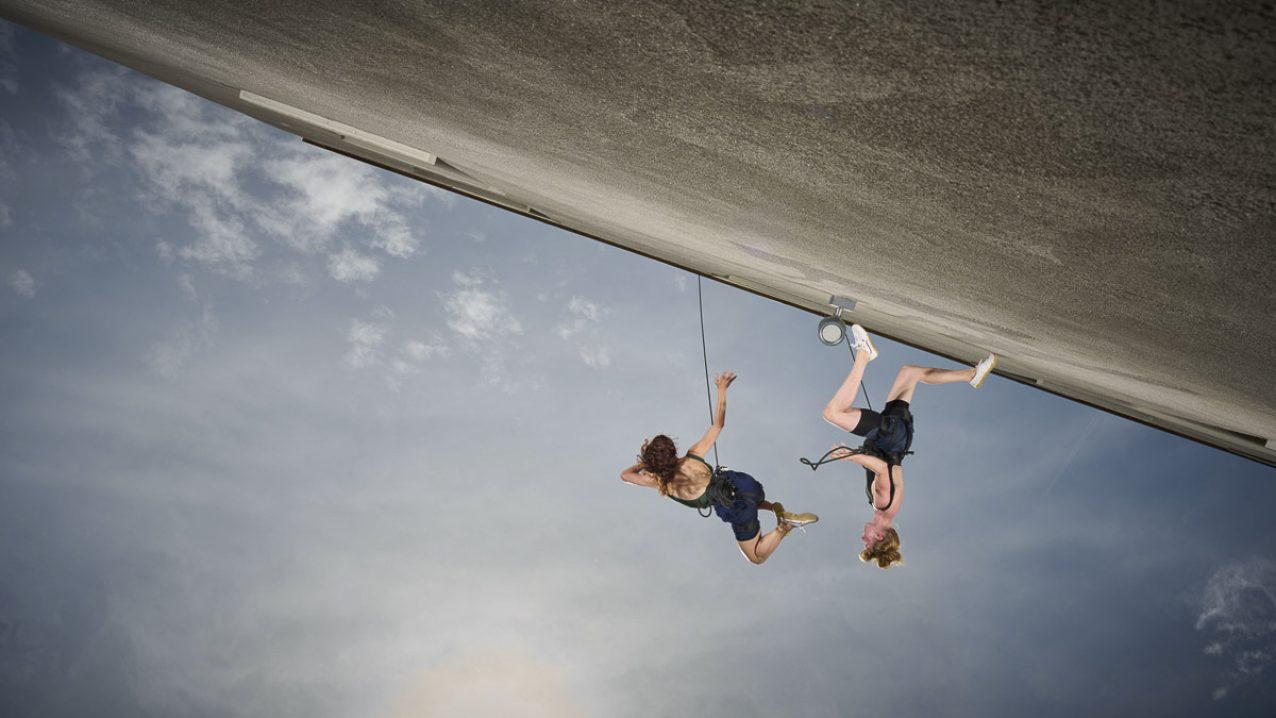
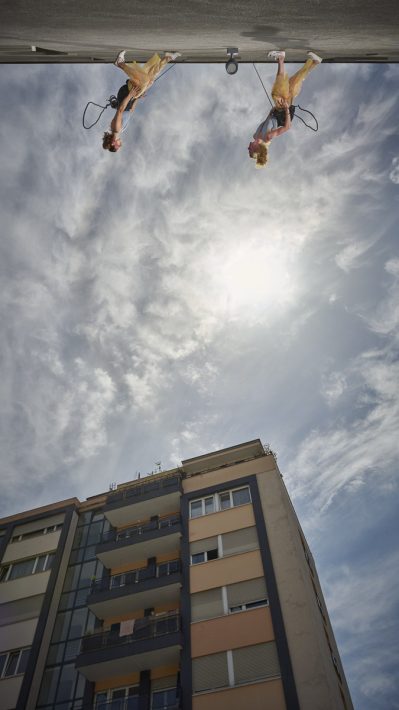
The dance duo, consisting of Laetitia Kohler and Rebekka Gather, requested two different kinds of images: photographs that were independent of any specific location (for the general promotion of future performances), and photographs that showed the current venue—the Théâtre du Jura in Delémont, Switzerland—which were less abstract and illustrated the concept of "dancing on the wall" more clearly.
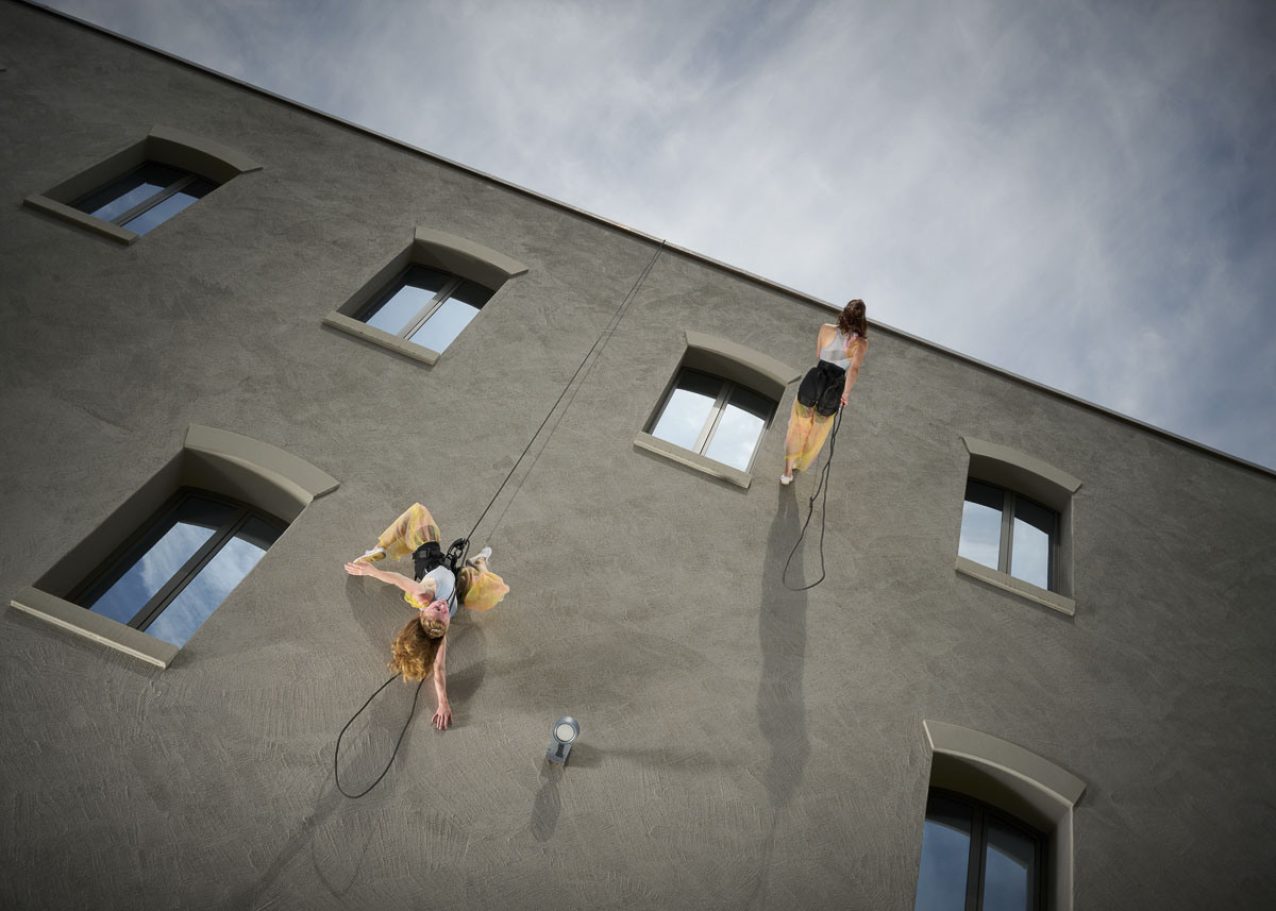
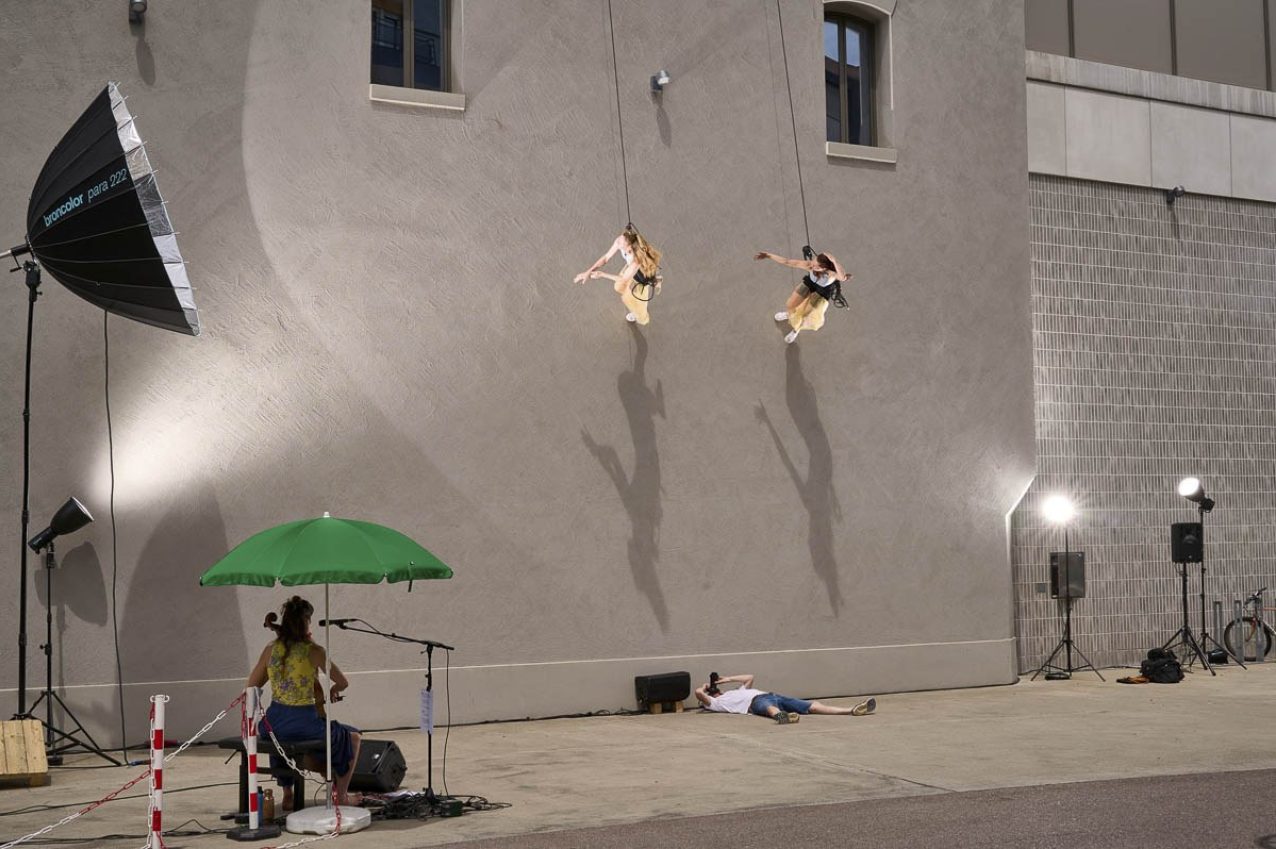
During the initial tests and while the ropes were being rigged, we were able to position and test our lighting. The sun was almost directly overhead, giving us a symmetrical starting point in which both sides were essentially identical, with one small exception. On the right, the wall had a slight projection behind which smaller reflectors could be concealed and aimed so that they illuminated the dancers on the wall without lighting the wall itself. This prevented the formation of multiple shadows. Unless I photographed very close to the wall, I had to contend with two shadows: the natural shadow cast by the sun and the shadow produced by my powerful flash units. But first things first:
Our very first step was to determine the camera settings. At ISO 100 and the shortest flash synchronization speed of 1/200 second, an aperture of f/16 gave us exactly the reduced level of ambient light we were aiming for. In the extreme backlight, the dancers naturally appeared as completely black silhouettes.
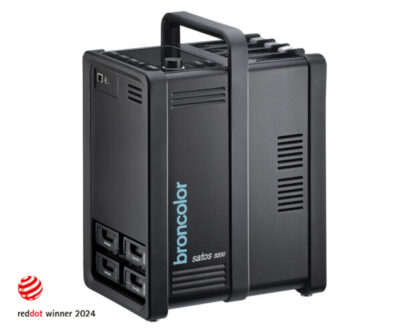
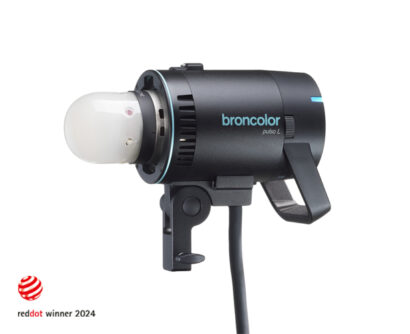
As our main light, we chose a Para 222 positioned on the left. Set to position 8, it delivered plenty of power, although it was not fully focused. The behind-the-scenes photographs clearly show that the Para illuminated both the areas above and below the windows—where most of the action took place. Inside the Para 222 was a Puls L lamp head, powered by a Satos power pack equipped exclusively with batteries. For safety reasons, we had also brought along a Satos 3200, as we did not know in advance how close we would be able to position the Para. In the end, however, the 1,600 J we had set proved more than sufficient as our main flash source.
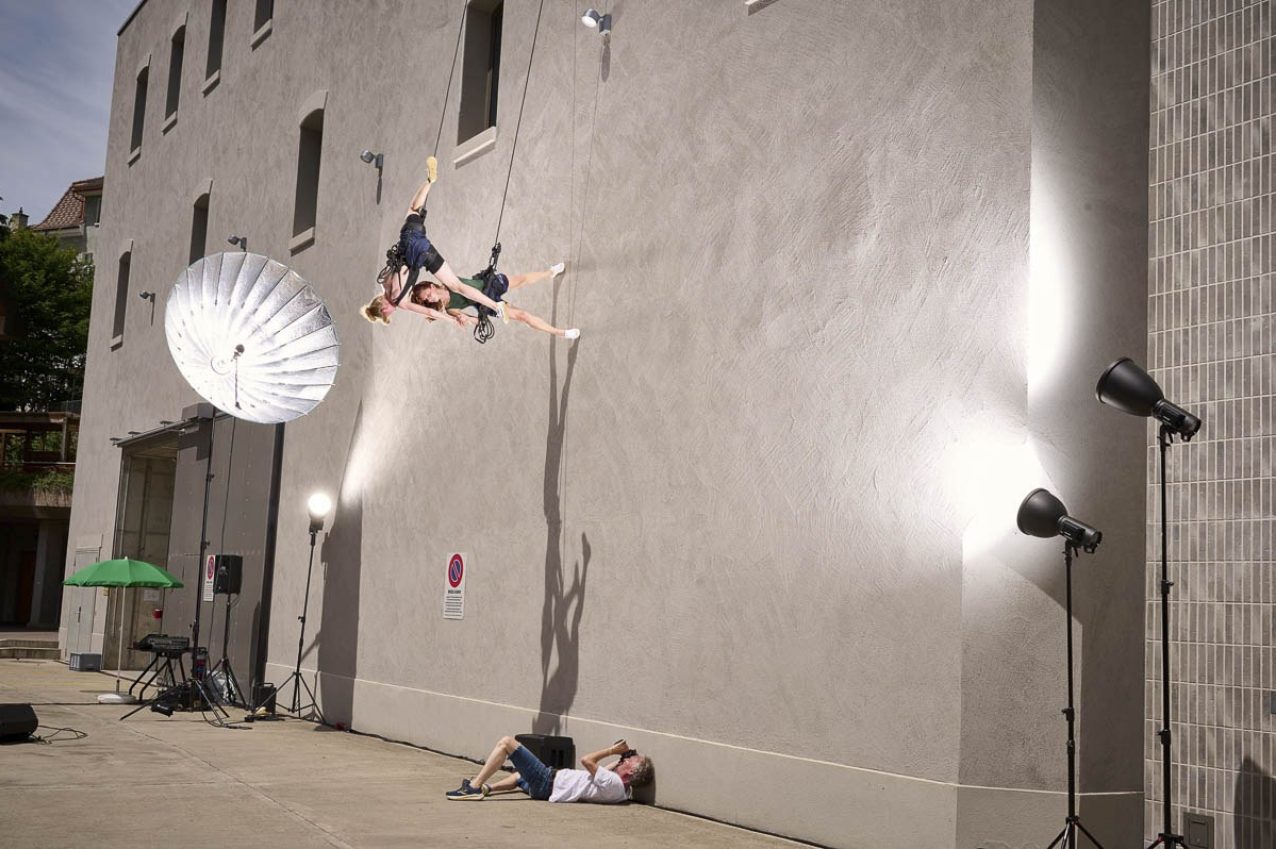
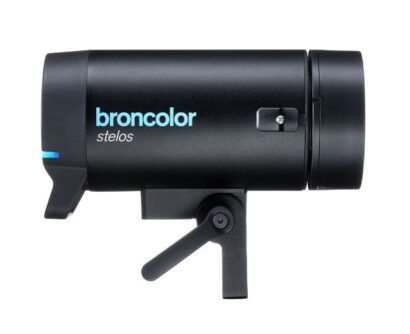
The Para was complemented by a P45 narrow-beam reflector mounted on a Stelos 800 L. The advantage of this reflector is its exceptionally high light output. However, because of its relatively narrow beam angle, it had to be readjusted from time to time as the performance gradually moved downward along the wall.
A big thank-you goes to my assistant, Masato Yano, for photographing the behind-the-scenes images.
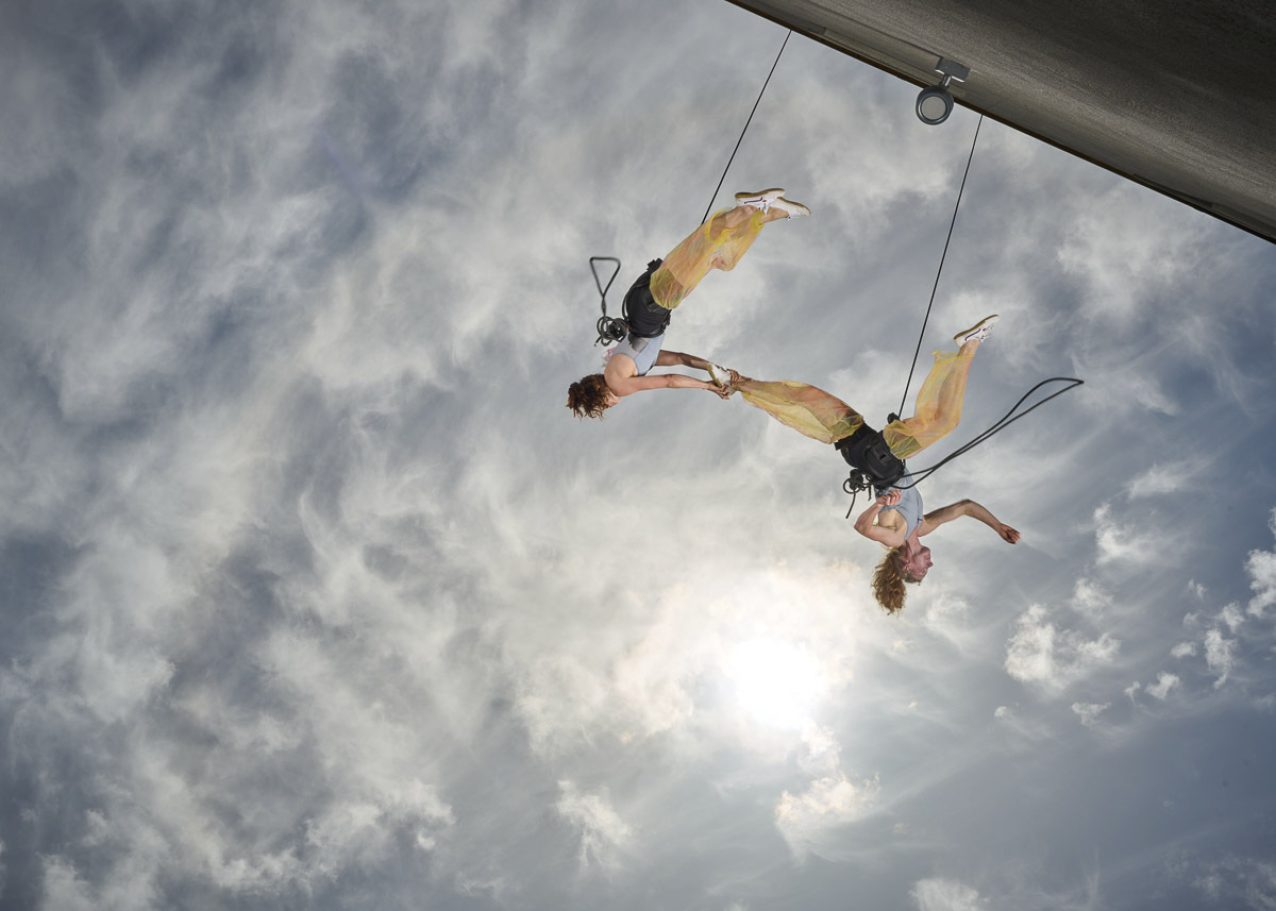
Speaking of the assistant's role: one of Masato's most important tasks was to check regularly that all the modeling lights were switched off. In bright sunlight they were virtually impossible to see, and photographically they made absolutely no difference. However, modeling lights consume battery power—which leads to a brief excursion into physics.
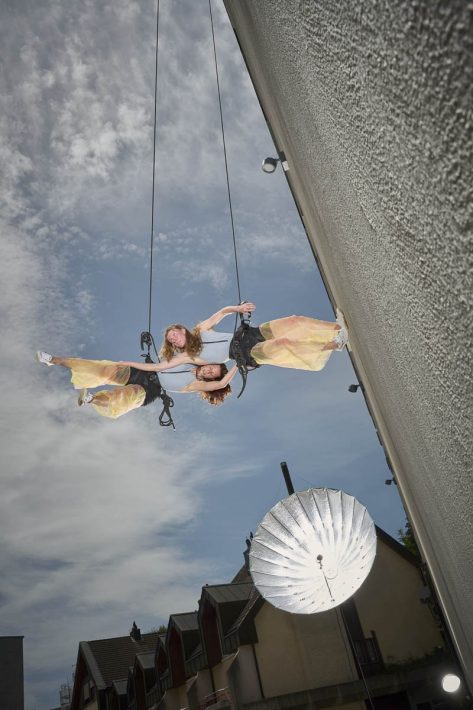
Flash energy is measured in joules (J), often referred to in the United States as watt-seconds (Ws). Although joules is the technically correct unit, the term watt-seconds creates a useful connection to continuous lighting, whose output is measured in watts. A Stelos 800 L delivers 800 joules (800 Ws) of flash energy and has a modeling light rated at just under 50 watts. If I leave that modeling light switched on at full power for 16 seconds, it consumes approximately 16 s × 50 W = 800 Ws of energy. In other words, one minute of continuous modeling light uses roughly the same amount of energy as almost four full-power 800 J flashes. A fully charged Stelos battery allows me to fire up to 300 flashes at full power, so a few minutes of modeling light is not a disaster—but it's still worth avoiding.
Back to the flash lighting—and to the other side of the set.
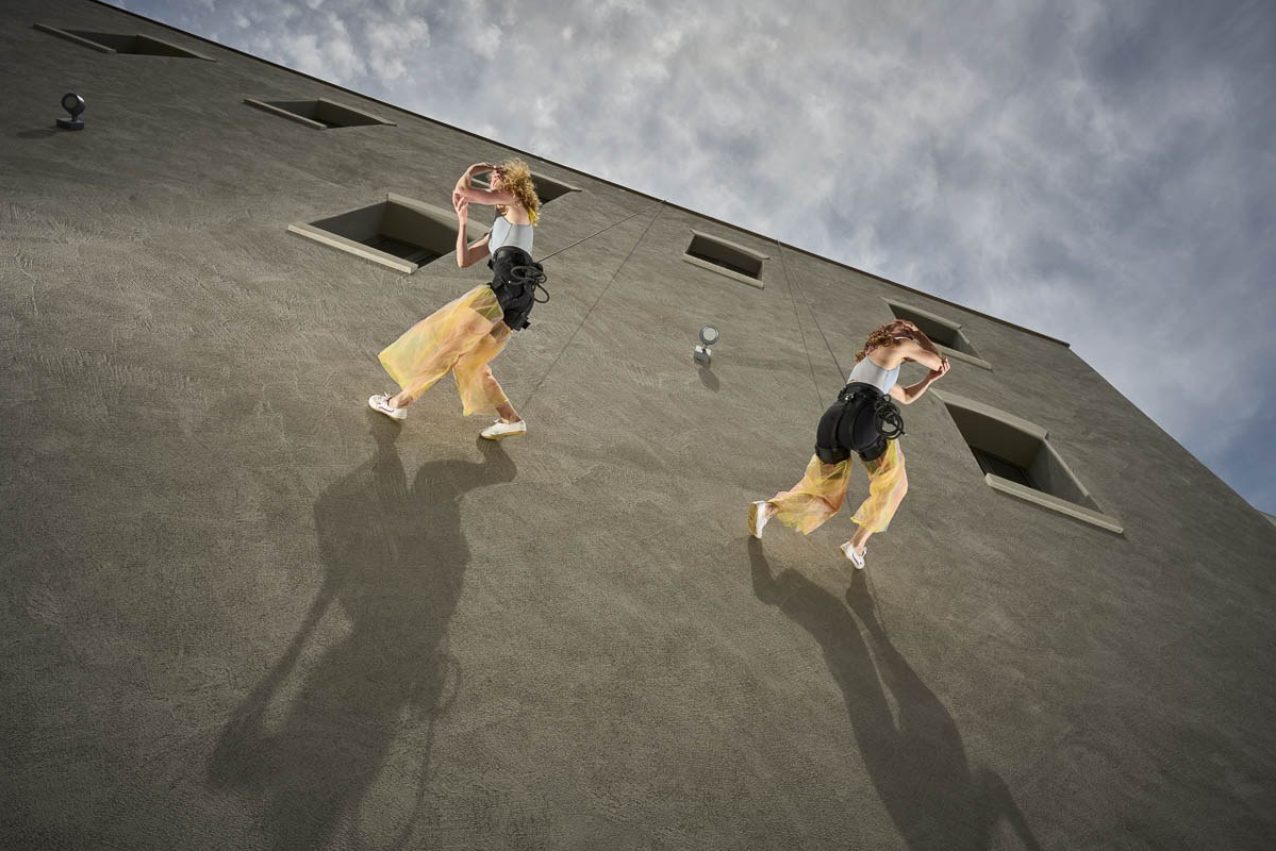
As mentioned earlier, two additional Stelos 800 L compact flash units were hidden just behind the wall's small projection. They were positioned so that the flash illuminated the dancers without spilling onto the wall itself. Whereas on the left both light sources—the Para and the P45—covered roughly the same area, the lights on the right had clearly defined, separate tasks. The area above the windows, which was farther away from the flash, was illuminated by a second P45 narrow-beam reflector. As on the left side, this reflector was powered by a Stelos 800 L set to its maximum output of 800 J.
In the lower section, where the dancers were hanging closer to the light source, I needed slightly less power, while a somewhat wider beam angle was actually an advantage. A P65 reflector offers exactly those two characteristics. (At broncolor, open reflectors are designated by the letter P followed by a number, which indicates the reflector's beam angle.) This P65 was also mounted on a Stelos 800 L, but in this case the flash output was set to 400 J rather than full power.
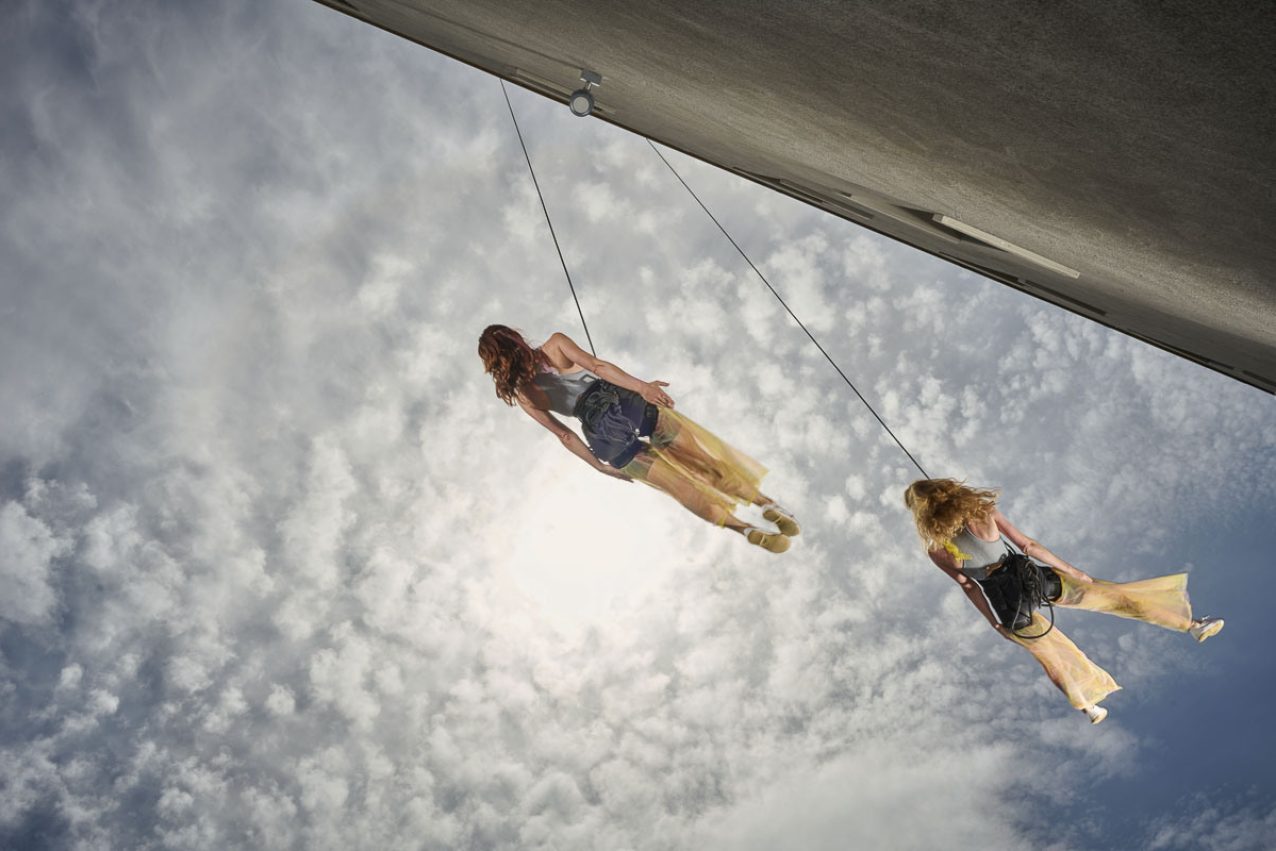
The Para contributed 1,600 J, each of the two P45 reflectors added 800 J, and the P65 supplied another 400 J. Despite the unusually large set, a total flash output of 3,600 J provided more than enough light to compensate for the exceptionally intense sunlight and allowed me to photograph in extreme backlighting exactly as intended. The high-efficiency reflectors played a decisive role in making this possible.
Over the course of 2.5 hours, we captured around 160 photographs. When it was time to pack up, the batteries in the Stelos units were still about half full, while the Satos power pack still showed 60% remaining. Under these demanding conditions, broncolor's battery-powered systems—the Stelos compact flash units and the Satos power pack—proved to be exceptionally reliable.